
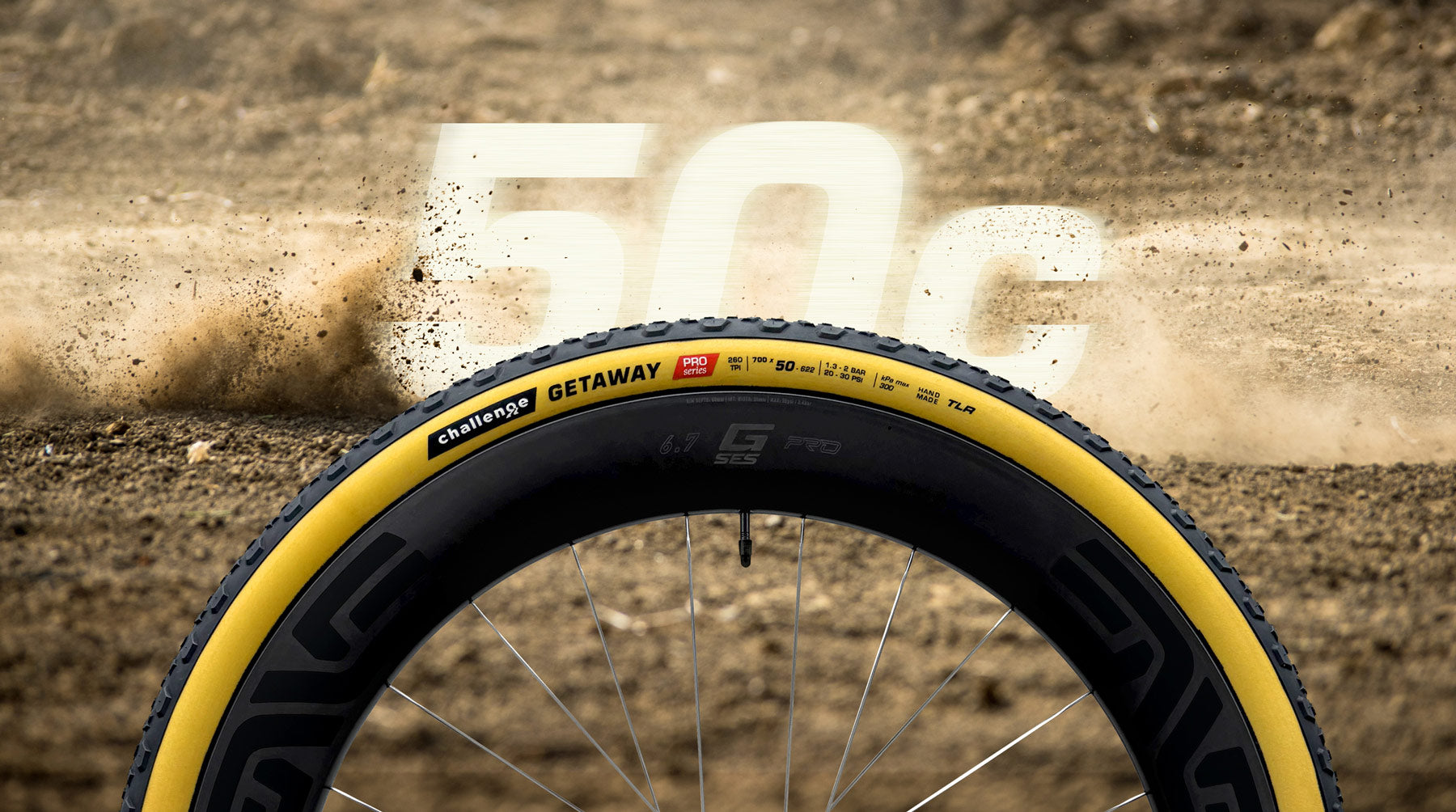
Bigger Isn't Just BIGGER: Why the New Getaway Pro 50c Changes Your Ride
Getaway PRO is our do-anything gravel tire for hardpack, intermediate gravel, firm-to-loose dirt, the stuff you actually ride most days. On top of 36c, 40c, and 45c, we're extending the range with a 50c. This isn't just "more tire" stacked onto an already-solid lineup. It's a different relationship to the ground underneath you, and one that independent testing backs up

More Rubber on the Ground
Contact patch (the actual footprint of rubber touching the road or trail) comes down to a simple relationship: contact patch area = load ÷ air pressure. Your body weight and bike stay roughly constant, so the variable you control is pressure, and pressure is directly tied to tire volume.
Wider tires hold more air volume, which means you can run meaningfully lower pressure while still supporting the same load without bottoming out on the rim. Bicycle Rolling Resistance's own pressure testing gives us real, measured numbers to build this on rather than estimates: for a 45-46mm actual-width tire (the tested width of the current 45c Getaway Pro), their medium pressure comes in at 38 psi, dropping to 35 psi in the 49-51mm band the 50c will land in. Compared to the narrower 40cversion’s 42 psi medium pressure, that's a real, tested downward pressure curve as width increases.
Run that curve through the load ÷ pressure relationship, and the 50c works out to roughly a 8-10% larger contact patch than the current 45c, and around 20% larger than the 40c, at equivalent load. Those numbers will shift a bit with your weight, rim width, and terrain.
Why Lower Pressure Actually Helps (It's Not Just Comfort)
The instinct is to think of low pressure as a comfort trade-off against speed. Testing doesn't support that framing, and the Getaway Pro's own results prove it directly.
Rene Herse's tire testing has been clear about this: “grip is as important as speed, and wide tires paired with lower pressure conform better to the terrain, which improves both traction and confidence.” And when Bicycle Rolling Resistance tested the Getaway Pro 45c, they measured 17.8 watts of rolling resistance, just a bit under half a watt more than the 40c version. Going wider, in other words, didn't cost anything in speed, it just added contact patch and compliance on top of the same rolling performance.
Worth noting: BRR's tested pressure numbers (38 psi medium for the 45c) are measured on a controlled indoor setup, and tend to run higher than what many riders prefer on actual terrain. A lot of gravel riders treat something like 30 or 35 psi as a ceiling, not a target, and for a rider in the 150-165lb range, 25 psi front / 28 psi rear is a realistic real-world starting point on a 45c, lower still on the 50c given the added volume. The contact patch math still holds either way, lower real-world pressure just means the practical gain from going wider is even bigger than the lab numbers alone suggest.
That translates to three concrete advantages with a wider Getaway Pro over its narrower siblings:
-
Lower operating pressure at the same load — both lab-tested and real-world pressures drop as width increases
-
Better casing compliance — the casing can deform and absorb terrain irregularities instead of transmitting every impact into your hands and back
-
Small rolling resistance penalty — going from 40c to 45c cost zero watts in BRR's testing ; there's no reason to assume width alone drags speed down
-
More consistent traction transitions — as surfaces change from hardpack to loose to chunky, a higher-volume tire holds contact rather than skittering
Which Brings Us to the Real Differentiator: How It's Built
Here's where the width story becomes about construction. A wider tire better delivers on that lower-pressure, higher-compliance promise if the casing itself can respond to load the way it's supposed to. Two tires can be dimensionally identical and ride completely differently, because the difference isn't the number on the sidewall, it's what's happening inside the casing under load.
This is where handmade construction outshines vulcanized. Our PRO series Getaway tires are built by hand by experienced craftspeople, using natural glues and latex coatings on ultra-supple casing materials. Compare this to a mass-produced vulcanized tire, where heat and pressure mold synthetic rubber to a low TPI nylon and cure the whole tire in one shot, sacrificing suppleness for ease of manufacturing.
Practically, this means:
-
Casing compliance and predictability — the handmade casing deforms consistently under load instead of behaving unpredictably at the edges of its range
-
Grip transition and sensitivity — you feel the surface changing beneath you rather than getting a delayed or muted signal through a stiffer vulcanized casing
-
Supple feel that holds up across conditions — the ride quality doesn't fall apart when hardpack turns to chatter or loose gravel
Performance isn't a spec on paper, it's what the casing actually does when it's loaded, unloaded, and reloaded thousands of times a ride. A wider handmade casing lets that lower pressure and larger contact patch actually do their job, instead of fighting a stiffer, less responsive structure underneath.
The Bottom Line
Extending the Getaway Pro to 50c isn't about chasing a bigger number over the already-capable 45c. The combination of width plus construction iswhat turns "more tire" into a genuinely better ride on the terrain you're covering every day.

Handmade Clincher Tires and Latex Tubes – Still Around for a Reason